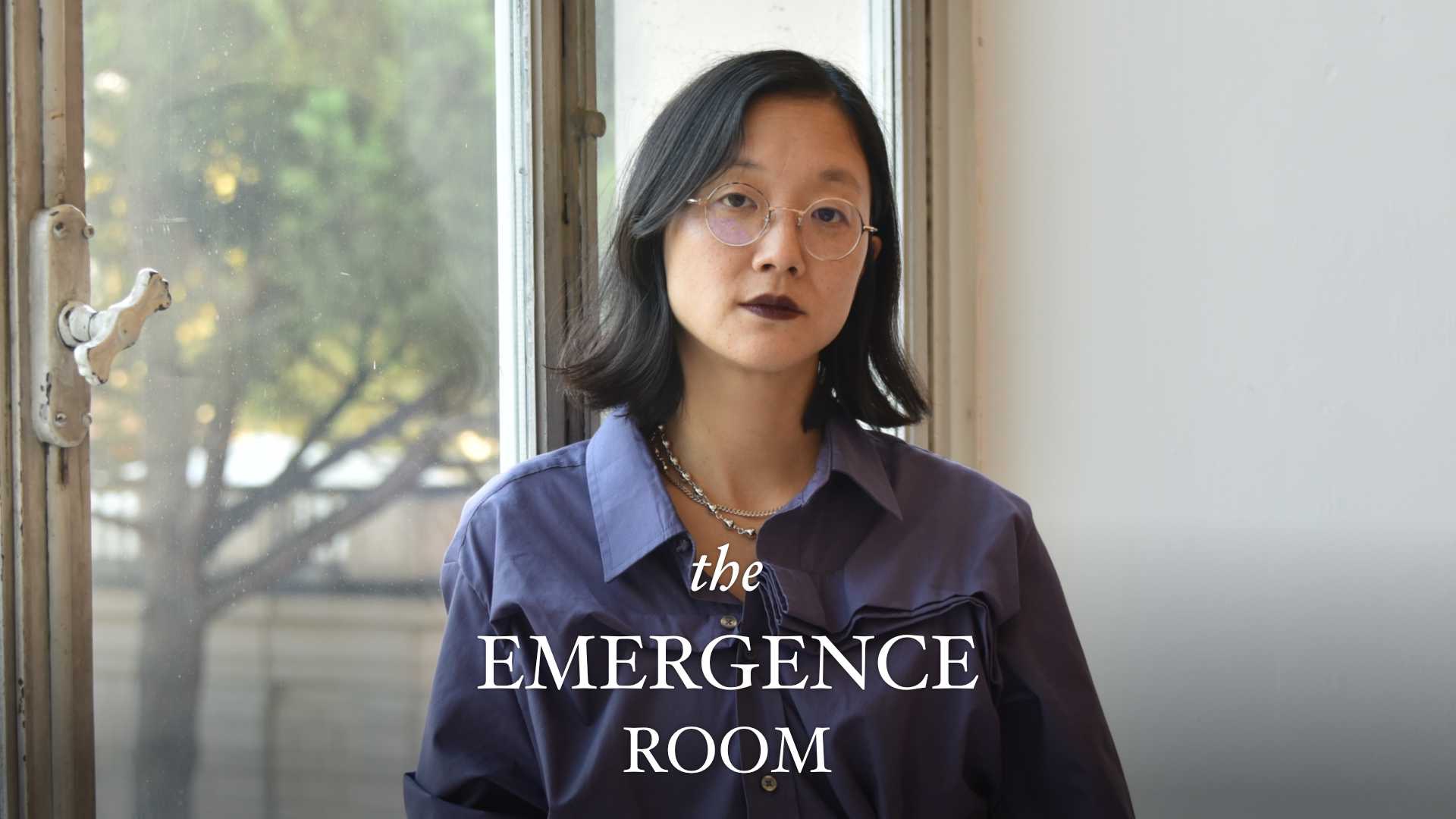
In this episode, we are joined by Christine Sun Kim, an artist whose work rigorously examines sound, language, power, and access. Christine’s practice challenges assumed hierarchies of communication and invites us to reconsider how meaning is produced, circulated, and authorized. Her work moves across drawing, installation, performance, and social engagement, often asking who systems are built for and who is required to adapt.
The Emergence Room is a podcast about becoming. It’s a space where artists and thinkers reflect on how ideas take shape through lived experience, friction, curiosity, and change.
Before we begin, we want to share a brief access note for listeners.
Christine is deaf. In this conversation, she is communicating in American Sign Language, with interpretation into spoken English. The voice you hear speaking Christine’s words reflects her authorship, perspective, and intent. We are in direct conversation with Christine throughout this episode.
Access is not an add-on to this dialogue; it is part of the conditions that make the conversation possible. Interpretation here is not a substitution or mediation of ideas, but a collaborative practice that supports shared understanding while preserving Christine’s voice and agency.
We offer this note not as an explanation, but as an orientation. We invite listeners to stay attentive to how communication happens in this episode, and to consider access not as a special accommodation, but as an ongoing, collective responsibility.
With that, we welcome you into the room.
Episode Transcript
TJ – You’re listening to The Emergence Room. I’m T.J. Dedeaux-Norris, artist, coach, and current Rome Prize Fellow.
00:00:08 – Jason – And I’m Jason Simanek, artist, fellow traveler, and co-host.
00:00:12 – TJ – This isn’t the emergency room where you go for crisis, though sometimes creativity can feel like one.
00:00:19 – Jason – It’s The Emergence Room, a space for artists and thinkers to process, to heal, to become.
00:00:26 – TJ – We’ll be talking with guests about art, academia, and the messy, beautiful process of emergence.
00:00:34 – Jason – So take a deep breath.
00:00:36 – TJ – You’ve checked into The Emergence Room.
00:00:41 – Jason – All right. We’re getting better at that.
00:00:46 – TJ – Okay, we’re getting better at it. Live is live. We are here in the room with Christine Sun Kim. So happy to have you here.
Christine – I’m happy to be here.
TJ – I just can’t help myself but to start with the kismet profound opportunity this is because when I did my interview for the Rome Prize, they flew me to New York, I had my interview, I had so much bubbling up inside of me, and I was like, what am I gonna go do now? I’m going to the Whitney. And there I was, all day, all night. So.
Christine – I love it.
00:01:53 – Jason – And you’re referring to Christine’s show at the Whitney, just so everyone listening knows.
00:02:00 – TJ – Correct. Just a little major survey of the artist’s career, you know.
Christine – [laughs]
TJ – I experienced every emotion possible in my body, in my spirit, with that show.
00:02:26 – Christine – So it’s like you needed a break or a reprieve and then you go somewhere to experience every emotion in your body. Was that a good break? You’re supposed to have no emotions during a break. Haha
00:02:41 – TJ – Well, I didn’t know what I was walking into, but I’m so glad that I did.
So, I hope through this conversation, we can dialogue about whatever you want. But, if something comes up about the show, there are certain emotions that we deal with in emergence – primarily anger, fear, joy, sadness, and hurt. You go for the gut punch with rage, joy, humor, and I’m so appreciative.
Christine – Thank you.
TJ – Thank you. Just wanted to put that out there. So now we’re just gonna get right into the question asking.
Christine – I’m ready.
TJ – Okay. So, Christine, where do you come from, personally, artistically, or scholarly? How would you want to address that?
00:03:47 – Christine – So I’m gonna say I’m gonna address it from a sense of geography. I come from California, and then after college, university, I found myself in New York. I lived there for 12 years. Then I realized this year is actually my 13th year in Berlin, which means I have lived there longer than I lived in New York, which I didn’t expect.
So, that’s where I come from.
00:04:19 – TJ – When you… arrived here and we were talking and we were talking about grad school. Is there anything that you’d like to say about where you come from within the context of school? You had some strong opinions which I can resonate with just if you want to.
00:04:44 – Christine – So I actually got two MFAs. So that means I went to two different graduate schools, the first one was School of Visual Arts, which was okay, not bad. And I feel like I kind of went there by default, in a sense of just going where society pressured me to go, doing what I was supposed to do. And I think mentally, I was actually not ready to become an artist just yet, even though I had finished my degree at SVA, I had some really amazing classmates and teachers, I just wasn’t there. I don’t know, it wasn’t the right place, right time.
And then I found myself thinking about sound when I was in Berlin for an art residency. I went to this big performance, Marina Rosenfield, in New York. And I saw that she was the co-chair of the sound music program at Bard MFA. So then I did my research. My curiosity was piqued. And I went to some open house or informational session. And I decided to apply and I got in. And then I had to ask myself, what does this mean?
Because I was so scared. Because I was ready. I was ready. Having fear meant that I was on the right path in the right direction.
And then I enrolled and I did the low residency MFA program, which means you are there for three summers. And so all the schooling was done over the course of three summers. And that was like one of my most traumatic experiences. I’m still angry about it to this day! A few people have said to me, like, move on, Christine. And I’m like, no. I like being mad about this. Let me be mad about this!
I think as somebody who doesn’t read lips, who doesn’t use her voice – so I use texting, gestures, sign language, writing to communicate – it was a real challenge. There was no one like me there. And there was one teacher who gave me a heads up and was like, Christine, you know, everyone’s so deep in their own shit. And so this means the students don’t really feel like they signed up to accommodate me or to adjust themselves to me.
I know that sounds harsh, but it was a good lesson for me because the art world is like that. I almost dropped out – I almost left many, many times. But then I decided to finish what I started with feelings of resignation, to be honest.
Now I have no regrets.
00:07:48 – TJ – So speaking of being deep in one’s own shit, I have a clarifying question in the context of this being a podcast and there will be listeners and people reading a transcription. When we started, I did not introduce your interpreter, Beth. I’d be curious if you could tell us live right now on this podcast, what is the best practice around how you … I’ve watched you talk about art world rage and all the things and translation and interpretation. Can you tell me a little bit about how you would like us to credit or talk about Beth’s presence here in our podcast?
00:08:57 – Christine – Generally speaking, in most cases, deaf people like to be able to be recognized for their efforts, and maybe the interpreter. And in other cases when an interpreter is recognized, sometimes the deaf person can lose their authorship – which I totally understand why that happens and how that happens. It also depends on my relationship. It doesn’t really bother me to acknowledge Beth, but the audience needs to know that what I am signing and what is being said is entirely my words. And so it depends on the interview.
But right now I’m happy to bring up the fact that I am being Interpreted and the English that you hear spoken is my words, but you’ve been talking to me directly just as you should be.
TJ – Thank you Thank you. Okay next question
Jason – Okay, I guess what what shaped how you make or think today? I That feels very open-ended, very broad.
But I guess what bubbles up when you get asked that?
00:10:21 – Christine – So I have a few moments that have happened to me since I’ve been in Berlin. The first time I went to Berlin was in 2008 and everyone’s like, “Berlin is the place for artists.” And at that time I was living in New York, having a lot of financial struggles. I was stressed out.
And so I decided to take a month break from New York and go to Berlin. And that was the first and last time that I’ve ever paid for an art residency. It was stupid, but ultimately worth it. And when I got to the residency, I found that there were a lot of people from the U.S. there. And a lot of those people I’m actually still in touch with to this day. It was just a wonderful group of people. And at that time I was a little bit – how do I say this? – I was aware that I was good and capable of socializing with people who don’t know sign language.
And maybe I should say this actually, like New York shaped me being really comfortable with strangers in close proximity, right? You ride the subway with people, you’re in small cafes, and so you’re around people all the time and I learned how to deal with that. I used to have a lot more anxiety about that. So those experiences and life in New York shaped me, that brought me to Berlin. Then in Berlin, because I had the shaping that I experienced through New York, I was able to enjoy myself a little bit better. I was able to bike around the city, go to clubs, go to bars, draw.
And that’s when sound came to me as a medium. And initially I thought it was a ridiculous idea, but it wouldn’t stop popping up into my head or presenting itself. So I registered that. I went back to the US and had to ask myself, “Why am I still thinking about sound?”
That’s when I realized that because how heavy the political identity of deafness can be – which I already felt like this way before gene therapy has gotten to the point that it has now – it’s just always that hearing people have been so obsessed with making us do things, behave in the ways that they do. Right? They should … that we should listen like they do, that we should enjoy music like they do, that we should talk like they do. And they’re just so obsessed with us.
It’s a little complex because deaf culture has its own culture, its own language, right? By having language, you have culture. And I realized that I’ve been living in a cute little deaf bubble at that time, like my sister’s deaf. And I hadn’t had any interest in leaving it and going into the hearing world. But I had gotten to a point where I had been successful showing the world that I could function in society without using my voice. But I also wanted to get to a point where I didn’t have to prove anything to anyone. So up until that point, I had proven that I could live without sound. And then after the Berlin residency, I realized sound had actually been in front of me the entire time.
So then I was wondering, can I use it as a medium? Could I use it as my material? Is it in my possession? So with all these questions, my journey started. So the Berlin residency shaped kind of who I am. But I’ll say that it wasn’t an easy journey. I didn’t have a frame of reference, right? There’s not a lot of criticism around art being made by deaf artists as a baseline. There are some artists who have had degrees of hearing loss that have had some, you know, work around them, but I really had to start from the beginning.
I had to try everything, and my last … “moment” perhaps, that shaped me is when I was playing with the sound equipment that I had bought because I’d gotten some grants and so I had my own funding. And I finally didn’t have to worry about whether the volume would break the speaker or whatever, right? It was my equipment – I paid for it and so I could break it if I wanted to.
So, I actually hired a tutor to help me order the right kind of sound equipment because I didn’t know, and so I thought I could just buy any plug because that’s all I’ve ever seen. People pick up two wires and plug them into each other, but it’s like, oh, some things aren’t compatible and that’s not how everything works. Oh, okay. So then I got a tutor and I practiced and played around and I blew a couple of fuses. I definitely smoked out a few speakers and then I got bored, right?
But what I realized in doing that is that I was able to scratch the itch I had around sound my whole life. And I think not being able to scratch that itch in a way has stopped the deaf community from being able to thrive because we’re being held back. But because I could play with sound without being observed or sensitive to hearing people, I could just do what I wanted. I could scratch that itch and then I could move on. And then I could explore my own ideas and my own sensibility around sound.
And I wish that all deaf people could have that opportunity around sound. Find out that it’s just this thing and then we can move on and maybe contribute by introducing our own ideas – new ideas.
And that’s one of the bigger reasons why I think the deaf community is not necessarily where it would like to be because we have all these prescriptions set upon us by others.
00:16:26 – TJ – I want to ask about the national anthem piece. So we talked a little bit at lunch or dinner about the timing of the exhibition. And I’m just curious hearing that, like … you, telling me that. But seeing the work in real time, I’m wondering … It felt very powerful, like a critique, and just powerful, watching the work, but I’m curious if you could talk a little bit about the timing of the exhibition, if you want to say anything about what we briefly touched on at lunch about … just the timing of the show and sort of how all of this is … political.
00:17:17 – Christine – So, my Whitney exhibition’s first installation day was the day after the current administration’s inauguration date. And the three curators that curated the show were trying to figure out the title of the show. Something that would … elicit flexibility around either result of the election. Something that made sense for both nominees winning. And so then the title of “All Day All Night” was proposed and that’s what we all agreed on and so it worked out.
I was a little optimistic. And then we … I don’t know if I’m gonna say like I felt emotions such as mad or sad, but I just felt like at a loss of knowing what to do about how the election went. And again, I felt really resigned.
And so then I just decided to focus on specific needs that are in my space, my family and my work. And I found myself closing myself off to protect myself. It was weird timing. And then after the opening, I felt like, “Gee, I should really celebrate.” But I saw the people. People’s strong responses to my show. And I think that made me feel that the show was maybe more urgent than ever. And it took me a while to accept the timing of it all. I’m happy now that it happened in 2025.
00:19:08 – TJ – Me too. So what are you becoming or unlearning right now?
00:19:20 – Christine – So early in my career, I felt like I was unlearning what I learned growing up, especially around sound and hearing people and unlearning all of those things. But now I feel like I’m becoming.
After such a huge museum show, museum exhibition, the archivist in me is like, great, we’ve got 13 years of my work documented in a catalog. The show is actually going to travel to the Walker Art Center after this. I’m very excited about that. But I see that the work has been documented officially. It’s filed away. There have been a few really great essays about it, which allow me to move on.
But I don’t think I will. With what’s happening now … I am getting pulled … backwards almost. I wanted to say, this is 13 years of my work, done and dusted, let’s move on. But somehow I’m revisiting my old material, not to unlearn it, but to maybe develop different vocabularies because now I have tools and now I can ask myself, “What can I do?” So I feel like I’m becoming.
00:20:48 – TJ – I really love that. In each episode, as a part of my sort of emergence coaching training, I’m looking for like an arc of like a from what to what for either the listener of the podcast or for me or for the guest who’s sitting here. And I’m wondering, you just hit on something and I’m like, oh, what if it’s looking back to the past, there’s a more … sort of, I’ll say … Mature and evolved – are kind of words that I feel like I have some judgments around those words – but like a part of you that’s prepared to go back to a younger career version of yourself and care for those materials and to care for your mind and your ideas in a way that maybe you just weren’t ready to do it yet. The work was maybe a little ahead of itself and now you’re coming back to it with new tools, lots of experience, and you can sort of shepherd it. You can sort of bring it into the world in a way that it’s maybe more clear.
And you talk a lot about not wanting to be misunderstood and so overcoming fear so that you are understood in text and the ways that you’ve talked about getting clarity, having clarity, not wanting there to be a misunderstanding.
So it feels like maybe this version of you is prepared to bring these ideas into a world where you’e more clear. And you will be – you will assure – that you are communicating what you want to communicate as an artist through the work.
Is that … ?
00:22:40 – Christine – Exactly, actually. And for the museum show, I had to confirm with the curatorial team when my career started, so to speak. I wanted it to be later, so less than 13 years. But they were like, “No, Christine, you have to add some of the earlier stuff” that I didn’t really want to.
What’s nice is that we found a clear year. It’s like, because who wants to see my grad school work? But we were able to kind of strike that date as the beginning. And before the Whitney show, I actually didn’t have a database. I was just kind of like working around sheets of paper, being in places, but because I had this opportunity, it actually forced me to get a database in place, and I did that with some funding and people support, and now I have a team.
You know, it’s been a slow start, but now, because of this exhibition, I have a confirmation of the date I started being an artist. I have confirmation of a milestone. I’ve got a timeline. I’ve never worked on a timeline. I freaked out to have to do that. But it forced me to go back. And it forced me to look back. And you’re right. By the act of looking back, I am becoming. And now that I have this catalog, I feel like… to ask myself what’s next or what do I do after that, it is the act of becoming. So exactly what you said.
00:24:24 – TJ – Well, I’m excited to be a witness and to watch it all take place. Or some of it, anyway. What’s happening here, yeah.
00:24:37 – Jason – It’s really inspiring. In the aspect of becoming, you had mentioned that the deaf community wasn’t where it wanted to be. That was some phrasing, but I thought that worked well with this question about becoming. I know you talked about your own personal becoming – but I guess, maybe I’m showing my ignorance – but what is the deaf, from your perspective, what does the Deaf community want to become? Is it about being understood? by the larger, the hearing community? Or … I’m just curious what that perspective is.
00:25:24 – Christine – I would say it’s not about understanding as much as just having our rights given to us.
So many people know what’s going on – incidental learning, having access to audio inputs – and we don’t. So I don’t know what’s going on, right? So it’s about access to information, with occupation and employment, I feel like … Why don’t we have 500 well-known deaf artists? We are people of a visual language, so where are they?
All we have really, historically, is like Beethoven, who lost his mind at the end … Goya. But I want sign language using deaf people. Those who use a visual language, we should be further in our lives than we are. Also, I think the deaf community needs more mentors. I didn’t have any until I went to Bard. And then at Bard College, I kind of had soft mentors. And they were amazing people. And I realize that mentorship has its power, but I had never had access to that before. That’s what I’ll say.
00:26:39 – Jason – Thank you. That was fascinating. That’s going to get me thinking. As I’ve been building, you know, as working in marketing, building websites and things over the years, accessibility has always been such a cornerstone of that work. Always trying to keep in mind that not everyone is equally abled, whether sight or hearing especially. But, so that’s just sort of inspiring to hear you talk about it in that … with that gravity. And it is urgent.
00:27:19 – Christine – It absolutely is. And it’s interesting because now public opinion – oh, let me just say in the US – In the US, public opinion on deafness is at an all-time high. We just have a lot of deaf characters in movies, commercials, TV.
So I hate visibility as a tool – eye roll – but it works. And so to acknowledge that is necessary, but we’re seeing institutional support getting stripped, cut, ripped away. So it’s interesting to see that public opinion on deafness is at an all time high and institutional support on deafness is maybe at an all time low. And what that means is that in five or 10 years time, public opinion will follow the downward direction of those cuts and that funding. And that comes back to access. Like I think it would be much harder for deaf people to get access when they ask for it in the next five or 10 years, which will have an impact on how deaf people get education and access to life.
00:28:24 – TJ – I think that’s a good place to ask our next question. And it’s certainly been …. this question I feel like is at the heart of my dissertation inquiry.
The question itself is, how do you balance creating, living, and staying well? The reason I’m really interested in this question is because as an individual that has experienced a lot of…
Christine – Oh, that’s a hard question!
TJ – I know, I know, but hear me out here. So I feel like as somebody who has experienced trauma, trauma, the research… Related to my work has required me to do a lot of research, to know a lot of facts that are enraging, upsetting. They hurt. And I have found that it has had an impact.
While I want to know all the data, I want to know all the information because I want to know how I can contribute or lead, or help, or be involved. The weight. And it’s sort of like in the auto-ethnographic type of way, I’m interested because I’m impacted, right? But it’s a lot to carry. So … I’ve had to do a lot of work on my personal well-being through EMDR, all sorts of somatic therapies … all the things. [laughs]
00:29:52 – Christine – I love EMDR.
00:29:52 – TJ – So, yeah, it’s a very helpful tool. So my question is, yeah, how do you… balance creating, living, and staying well?
00:30:05 – Christine – Right now, I feel like there are two reasons … Well, I think I’m always going to struggle to find the right balance, so let me say that … But I feel like right now I’m in an okay place, kind of. And two big reasons for that is because, or two big reasons for that are because, the place that I’m at in my career is not early career. I’m at a place where people know about my work. It has made things easier.
Like I was able to get the residency here because people know my work. And now if I ask for things, most likely people are willing to make that work compared to earlier on in my career. People really love to say no to my requests. So it’s interesting to see how I can see things in numbers now. I can see that I was brought here so that I had financial assistance for my flight, having my family here as its own cost, having my interpreter, an au pair … I can see things in numbers now. Dollars, euros, whatever currency. I can see that people have to ask themselves if I’m a worthwhile investment or not. And I think that’s one of the reasons why I really struggled with Bard College because they felt like they were spending so much on my access because there were eight weeks of classes, crits, studio visits, social events. So, interpreters were working all day, all night, basically to squeeze in a year’s worth of education into eight weeks. A year’s cost got squeezed into eight weeks cost. And I think that if I was not where I am now, Bard would have looked at me as a waste of money.
And it’s interesting because I feel like I have to think this way because I’m somebody that you can put a price on in that sense. But being at where I am in my career has helped me a lot. It’s given me a lot more flexibility. I can find space for myself to make work, to rest. And I can … this is if I want to, if I’m capable of telling myself that I can.
But I also just, second reason, have an amazing partner. I have such a good teammate. We always make sure to take turns. And so when this opportunity came up in Rome, I kind of immediately thought that I couldn’t do this. But he was like, no, let’s do this. I’ll help make it happen. And so having his support has just been unreal. I’ve got an amazing teammate.
Those two things being in place have helped me find balance between creating, living, and staying well.
00:33:04 – TJ – I can relate.
Christine – Aw!
TJ – Yeah, yeah. Having a wonderful co-conspirator in life and creativity is such a gift.
00:33:23 – Jason – Well, and to have somebody that supports… not just supports, but pushes too, is really remarkable. Just, I think that’s such a massive change in my life. Her impact as to just, like she can recognize there are things I want and that I might not go get without some push.
00:33:47 – TJ – And I think we talked about a little bit of that when we learned that both of our partners went to grad school late in life at the, Um… [laughs] coercing, advising, gentle encouragement of us. [laughs] So, yeah. That’s beautiful. Okay.
00:34:15 – Jason – It’s appreciated. I’m not taking it for granted. We’ve got one more question.
One final question for you. I’ll ask it.
00:34:23 – TJ – Okie doke.
00:34:24 – Jason – What do you hope others take from your work or process?
00:34:29 – TJ – What’s sort of the the yeah, the lesson, or the concepts, or the or do you want anyone to take anything away?
00:34:48 – Jason – Just what you were saying about your own visibility, helping, like you have the show and now people have your name and they’re like, “Oh, how can we support her? Make accessibility for her?” I guess I would hope that you being visible as a member of the deaf community helps create visibility for the whole community to some extent.
00:35:20 – Christine – So, you know, I struggle with that concept because honestly, it’s not in the forefront of my mind. I’m not making my art thinking of the community. I’m an artist. And so I’m like, “How do I say this on paper?” … The thing I want to say. But I don’t really think about what people can take away or learn. Sometimes I don’t even want people to understand. I’m okay with sharing. I’m happy to share. And what you take away or what you learn is up to you. And maybe it’s because deep, deep, deep down inside I’m thinking about deaf kids and what they’re seeing is possible. And so I do hope, if anything, that deaf kids are okay. I hope they survive this crazy life.
00:36:13 – TJ – Yeah. I really appreciate that. And I ask the question, these are questions that I’m even trying to address for myself as an artist. And sometimes there’s a lot of pressure to think that there’s a responsibility, you know, based on the bodies that we’re in, the communities that we belong to … that there’s some sense of responsibility. And it can be really overwhelming. At least for me, it has been. And wanting to almost…
00:36:47 – Christine – It is overwhelming. I believe you!
00:36:48 – TJ – And, like, just wanting to be irresponsible. Like, I don’t want to have to do anything, you know? I just want to…
Christine – Nothing at all.
TJ – Yeah. Yeah. So it’s something that I’ve certainly been thinking about for the last probably decade. And I think it also shows up maybe when you get invitations to come to do a lecture and sort of the preamble of how they’re framing you in their invitation of like, “Well, who’s funding it?” It kind of gives you an idea of maybe what sort of lens or perspective they’re asking you to show up as a lecturer or something like that. But just thinking of different things like that.
00:37:36 – Christine – I agree with you. And I’m getting to the point where I just want to have so much fun. I want to have so much fun [laughs] to make up for what I missed out on when I was younger. So I almost never say no, right? I’m always saying yes to new experiences, yes to meeting new people – to make up for that. And I think that sometimes it’s a shallow answer. People will ask me, like, what do you want? What do you hope to get out of this? And it’s like, I just want to fly to Rome and be in Rome. I want to go shopping. I want a new ring. I don’t know. I want to have fun!
00:38:17 – TJ – That’s amazing.
00:38:21 – Jason – I think that’s great.
00:38:23 – TJ – Yeah. And I think we’ll sort of wrap it up here. But as I put on my little doctoral cap again for a moment, it makes me think of sort of also part of my dissertation topic, I believe, is like institutional attachment versus authenticity. Like just showing up as ourselves. And ourselves might not be authentic, a fully responsible person. Like, I want to turn up. I want to drink wine. I want to hang out. I just want to be here and represent myself, not the attachment to the institution that I’m connected to or anything like that. Just want to be me and become, as you so beautifully said.
So … that’s it! I think we’ve landed on a lovely… landing pad. And I want to thank you so much for your time. And um … I guess the last note that I’d like to leave is well you may have a competing artist in your family, because Roux is going to come do some prints here tomorrow in our studio. So … [laughs]
00:39:34 – Christine – Yes! Oh, I’m excited. Yay!
00:39:36 – TJ – So we’re thrilled to have her here.
00:39:41 – Christine – Well, thank you so much for making time and space to welcome me and my family. I mean, we’re studio neighbors, so I’m really thankful for that.
00:39:51 – TJ – It’s been an absolute pleasure, so, thank you.
00:39:55 – Jason – It really has.
00:39:55 – TJ – All right, till next time, y’all, on The Emergence Room. Thanks for tuning in!
00:40:03 – Jason – Goodbye!
00:40:04 – Christine – Bye!